fshr
The musings of a grumpy hairless ape
Solar & Battery
Introduction
We’d wanted to get a solar system installed for a while now. Both from the point of self-generation to reduce electricity and gas bills a little, and also to try and do our bit for decarbonisation of the energy we use (particularly around gas).
Solar however isn’t a cheap investment, and I prefer to avoid borrowing money as much as possible, so it was largely something to do “in the future”, with little hope of actually being able to do it. However, the unfortunate passing of a family member left us with a small block of money to spend on home improvements, of which solar is one item.
The System
For the system, I looked at a few options for solar, and there’s now a few different options on the market, particularly when it comes to different inverter types (string vs micro), battery types (AC vs DC coupled), and of course manufacturers.
It would be an entire article in it’s own right to go over the positives and negatives of the various technical options, but after researching the options I felt that as we’re in the UK and would be going with a dual aspect setup (E-W), then microinverters coupled with AC coupled batteries would provide the most flexible option for us.
For the supplier, while there’s now a wide range of companies who will happily sell you a solar system, we ended up going with Heatable. Heatable work by being a “front end” to a network of installers who do the work on their behalf. You discuss options with them, decide on the system you want, they do the design, and they then monitor and guarantee the work done. It does work out a little more expensive than other suppliers, but from their YouTube channel and website, they seem to have a clue about what they’re doing and aren’t just “box shifting” kit to get it on people’s homes and get paid.
I’d been through said videos and did some research myself, but Heatable also schedule a design/consultation call to go through requirements, etc. This was actually quite useful, as the design in my head was somewhat “over-engineered” and got scaled back and simplified somewhat! From that, they provide 3 options with pricing and you simply pick the option you want, pay the deposit, and you’re started!
From the options we had, we ended up picking a system comprised of:
- 15 × 450W REA Power solar panels (450W each), with
- 15 × Enphase IQ8HC microinverters (380W each)
paired with:
- 2 × Enphase IQ 5P Battery (5kWh each)
That spec gives us a 6.75kW solar system with 10kWh of attached battery storage. That’s estimated to give us a total estimated annual output of around 5,250 kWh (obviously depending on weather). While that’s more than our (current) estimated electricity usage, our generation across the year isn’t going to align perfectly with our usage.
For one, we’ll generate more in the summer than winter, and more during daytime than nighttime; whereas our usage is likely to be skewed the other way, more usage over the winter and during the morning/evening. Hopefully the battery can help “correct” the day/night skew a little by charging in the day, and discharging at night, but we’ll also need to make good use of an export tariff to sell some of the excess daytime power to offset any we buy back at night. Also, we installed a heat pump which will decrease (or remove) our gas usage, but at the cost of increased electricity usage.
One other advantage of the Enphase] hardware is that it has an out-of-the-box HomeAssistant Integration which should mean that both the solar and batteries will integrate nicely into my existing HA setup. It’s also a (mainly) local integration, with all of the communication taking place on the local LAN between HA and the Enphase Gateway (it does still require a once yearly connection to Enphase cloud to get an auth token however!). This should mean quicker and more reliable updates and control in HA as it’s nt doing a round-trip out to t’Internet and back (this is also one reason why I went with Enphase for the batteries as well as the inverters).
In early 2026 we did a minor upgrade on our system. As part of the initial install we had an Envoy-S Metered installed as the system controller. This is a fairly basic controller with no bells and whistles (other than having CT support). We’ve now replaced that controller with an IQ System Controller 3. The main difference with the System Controller is that it provides microgrid interconnect device (MID) functionality. This means that we’re now able to operate off-grid in the event of a power cut or other issues with our grid supply.
Home Assistant Integration
As noted above, there is a native (now Platinum) integration for Enphase which provides information on both the solar and battery parts of the system. Installed and connected to my Envoy, this gives me devices for the Envoy itself, the 2 batteries, and each of the 15 microinverters on the solar panels:
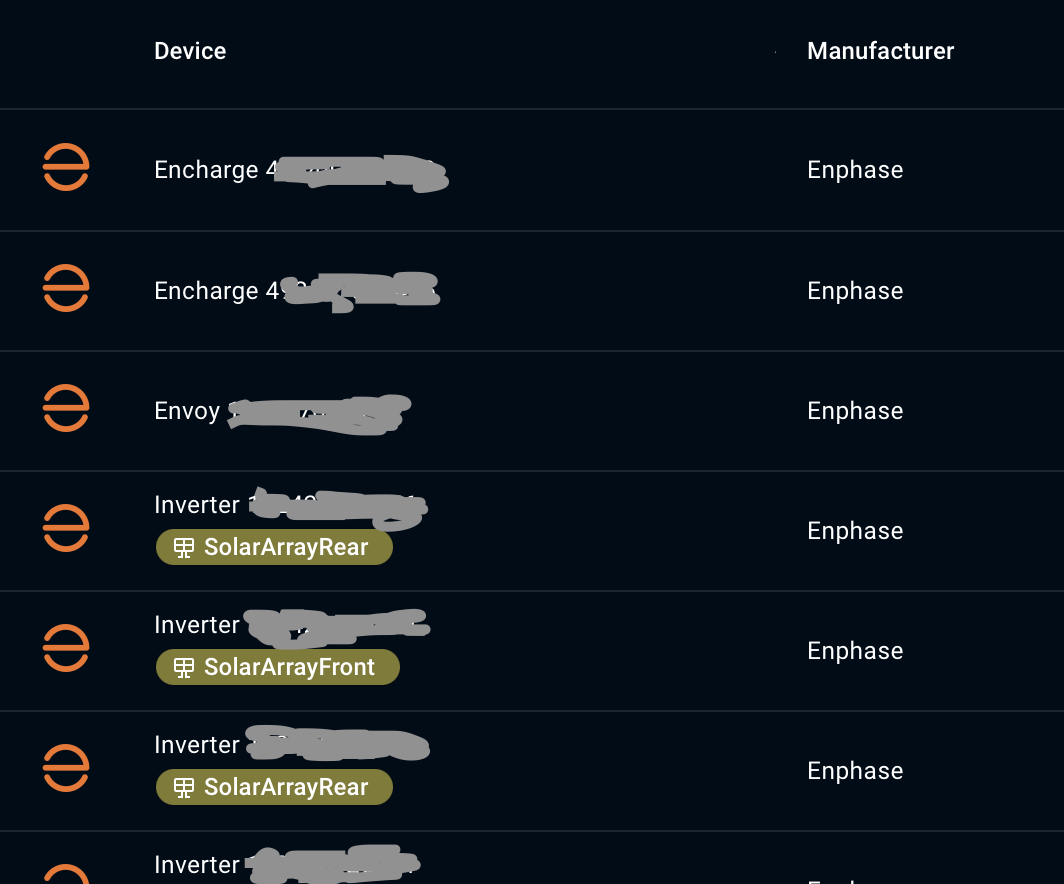
Across the devices, you get a set of entities mainly covering the power and energy stats for the devices:
- Inverters - Output (W)
- Battery - Charge (%) and Power (W / VA)
- Envoy - Power (W / kW) and Energy (kWh) for the system as a whole, for Consumption and Production, and for Now, Daily, & Lifetime.
If you’re a bit of a data nerd, this then opens up a whole set of datapoints to play with, and colorful dashboards to build:
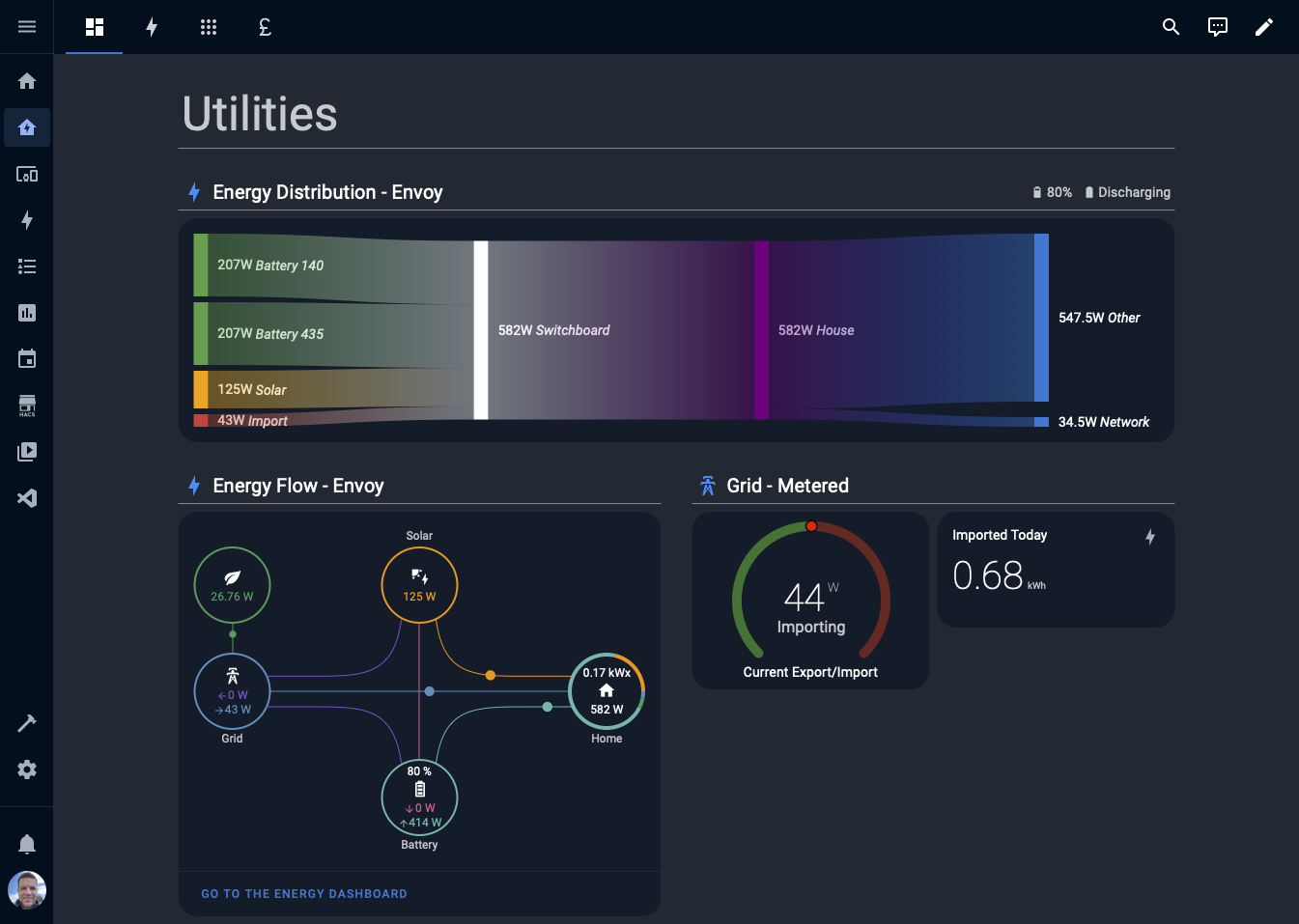
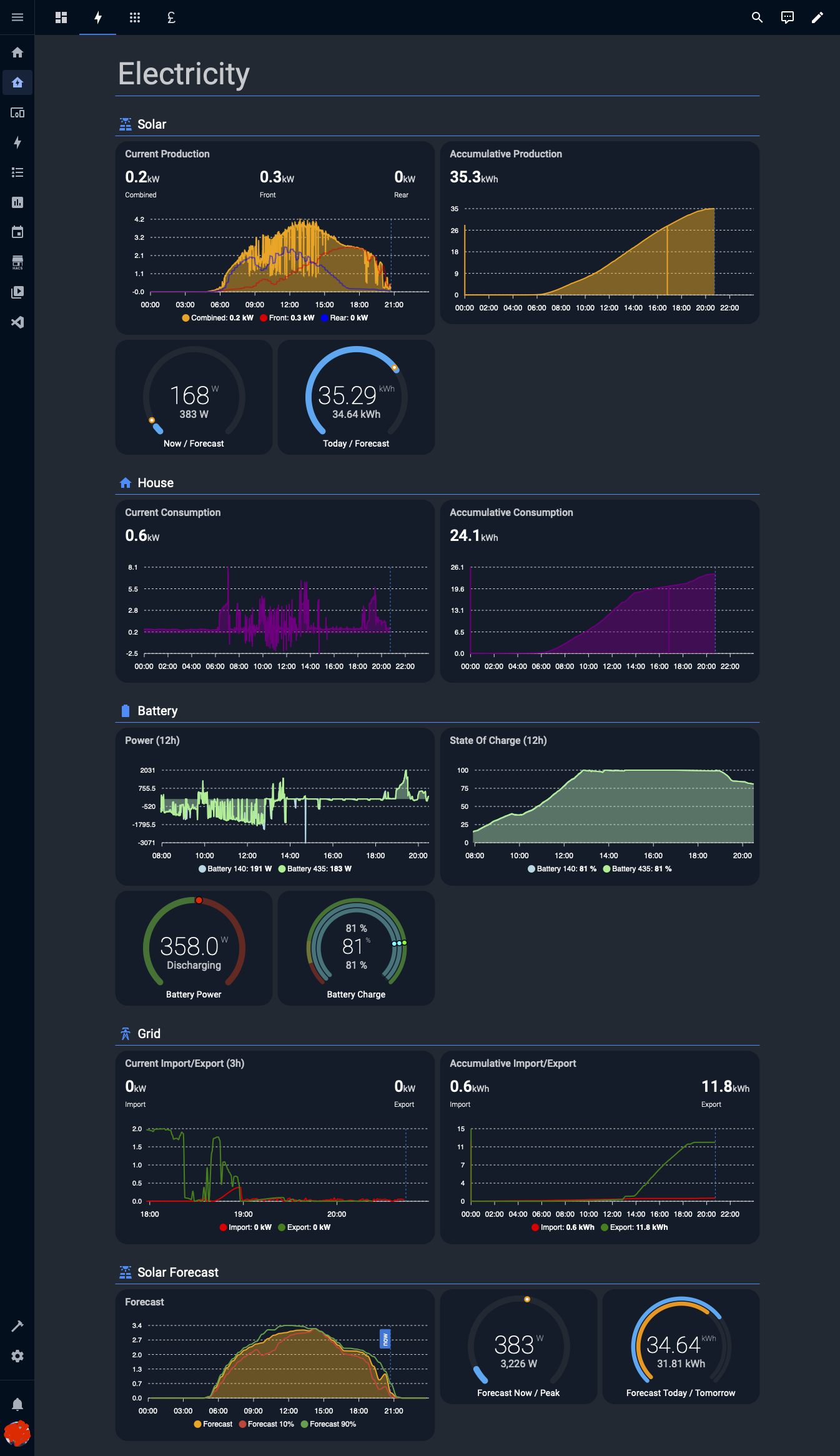
Once we’ve got a couple of months of solar under our belts, and hopefully (soon) some exports set up, I’ll post some more stats and info on how it’s doing.
© Paul Fisher 2026 / CC BY-NC-SA 4.0


 / Disclaimer